Restaurant Tip Pooling Laws in 2026: What You Need to Know
Restaurant tip pooling eligibility, notices, adjustments and records need review against federal guidance and the restaurant’s state and local rules.
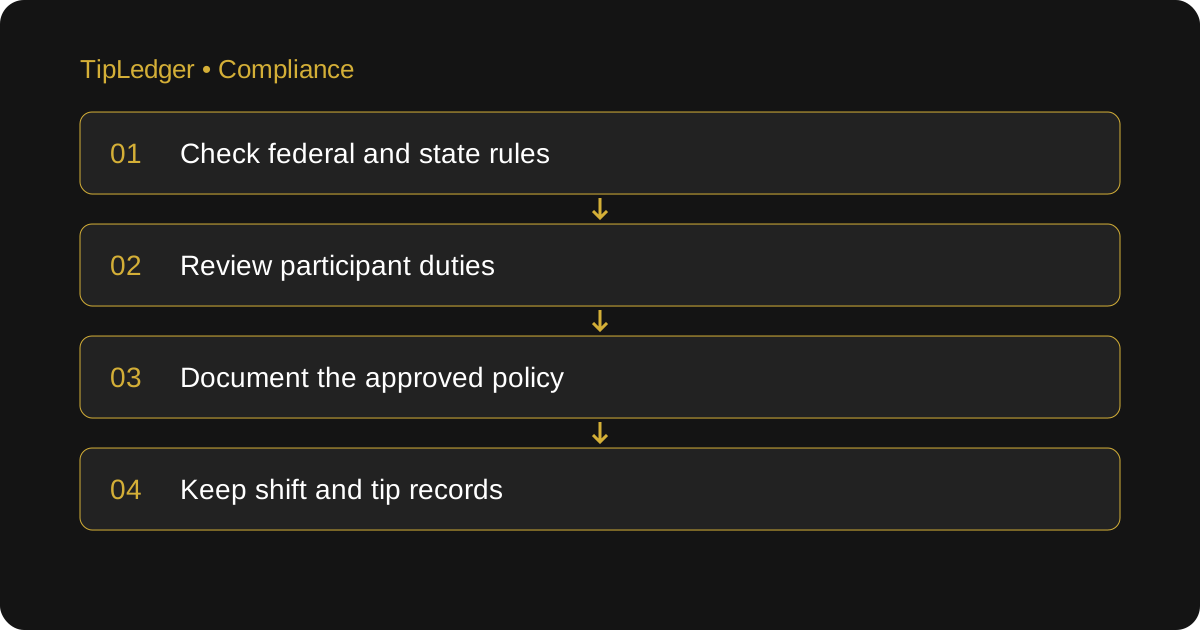
Check the policy against the restaurant’s actual setup
Restaurant tip pooling collects and distributes employee tips under a defined policy. Eligibility depends on federal, state and local rules. A restaurant tip-pool review starts with facts: where employees work, whether the employer takes a tip credit, who participates and what each participant actually does. A job title or a software setting is not enough to answer those questions. This guide provides a review workflow for owners and managers in 2026. It does not claim that every state changed its rules this year or provide a complete state-by-state legal determination.
Use current U.S. Department of Labor guidance alongside the rules for the restaurant’s state and locality. The official source links below explain the federal framework. Before introducing or changing a pool, have the specific arrangement reviewed by a qualified adviser or the appropriate labor agency. Keep the reviewed policy and the facts used in that review together.
Establish the federal framework first
Under the federal framework, a mandatory pool involving workers paid with a tip credit is limited to employees who customarily and regularly receive tips. If the employer pays the full minimum wage without taking a tip credit, federal rules may permit a pool that also includes workers such as cooks or dishwashers. Employers, managers and supervisors cannot receive other employees’ tips from a pool. State rules can be more restrictive.
A manager’s own customer tip is a separate issue from receiving a pool share. Federal guidance addresses tips given directly for service the manager directly and solely provides; it does not permit the manager to take a share of other employees’ pooled tips. Check actual duties when assessing whether someone is a manager or supervisor. Renaming a supervisor “shift lead” does not settle the question.
Gather the facts before choosing percentages
Build a participant list that records the role, actual duties and whether the person has management responsibilities. Separately record whether a tip credit is taken and the applicable work location. Ask the reviewer which roles are eligible for the particular arrangement. Do not configure percentages first and then assume every name on the roster can receive a share.
Include employees who change duties during a day. A person may cover a floor position for part of a shift while holding responsibilities that affect the legal analysis. Record that situation for review instead of allowing an informal exception at close. If you operate in more than one jurisdiction, evaluate each location’s arrangement rather than copying a single policy because the restaurant names and menus are similar.
Distinguish tips from other amounts
Keep voluntary tips, mandatory service charges, cash declarations and any proposed deductions separately identified. Ask how each amount should be treated for the restaurant’s policy and payroll process. Do not use a generic “tips” column to combine amounts that may have different rules. A report that balances arithmetically can still classify an amount incorrectly.
Credit-card processing adjustments also need review under the applicable rules. The fact that a tool has a field for a fee deduction does not establish permission to use it. Record the basis for an approved adjustment and keep the source total visible. Check customer refunds and late payment adjustments as their own exceptions rather than removing a lump sum from whatever pool is currently open.
Write a policy employees can follow
Once the arrangement has been reviewed, write down the participating roles, contribution basis, distribution method, timing and effective date. State whether an amount is based on sales, tips, hours or points. Explain partial shifts and role changes. Confirm required notices and disclosures with the reviewer, especially where a tip credit is involved; do not assume the same notice satisfies every jurisdiction.
Include an example of the approved arithmetic. For illustration only, a $100 eligible pool divided among ten eligible pool hours gives $10 per hour. A participant with four hours receives $40 and two participants with three hours receive $30 each. The shares total $100. This demonstrates an hours calculation, not that the participants or policy are lawful. Eligibility must already have been established before the arithmetic is applied.
Keep records that explain the result
Save the effective policy, source reports, participant information, hours used, contributions, distributions and approved corrections. Give a reviewer enough information to trace an employee’s figure back to a particular shift. Keep original and corrected versions distinguishable. Record why a change was made and who approved it, instead of overwriting a total with no explanation.
Federal retention guidance distinguishes record types: generally three years for payroll records and two years for records supporting wage computations. State requirements or another applicable obligation may require longer retention. Confirm a schedule for the restaurant rather than treating one minimum as permission to discard everything. Include exports and source documents in that schedule, and restrict access to employees’ private information.
Review changes and exceptions before using them
Revisit the arrangement when duties change, a new role joins the pool, the restaurant changes its wage approach or a new location opens. Assign someone to check current agency guidance and record when the policy was reviewed. Do not assume an annual article title means a policy has been legally approved for the current year. Check the source’s publication or revision date and whether it covers your specific situation.
TipLedger can apply configured tip rules to the figures entered and keep key activity records. It does not certify compliance, determine employee classification, run payroll or calculate and file taxes. Treat it as a calculation and record-organizing tool. An unusual participation question or a proposed deduction should go to the responsible adviser before it becomes a routine setting.
Official sources and a final review checklist
Read the linked Department of Labor fact sheets on tipped employees, managers and supervisors, and recordkeeping. Use the agency’s state labor-office directory to find the appropriate state authority. Confirm the work location, tip-credit approach, participant eligibility, treatment of charges and adjustments, required notice, distribution timing and retention schedule. Keep unanswered questions assigned to a person who can resolve them before the next policy change.
Sources and further reading
- U.S. Department of Labor: Tipped employees (Fact Sheet 15)
Federal rules for participant eligibility, tip pools and service charges.
- U.S. Department of Labor: Recordkeeping (Fact Sheet 21)
Primary guidance on the hours, pay and supporting records behind the shift review.
- IRS: Reporting Tip Income (Publication 531)
Primary guidance on daily tip records, cash and charged tips, and tip reporting.
- U.S. Department of Labor: Managers and supervisors (Fact Sheet 15B)
Check actual duties when reviewing manager and supervisor participation.
- State labor offices
Find the agency for the restaurant’s state; federal guidance is not the whole rule set.
Ready to simplify your tip distribution?
Try TipLedger free for 30 days. No credit card required.
Start Your Free Trial